


Quick answer: Pipes shift underground because of a combination of natural and man-made forces, including soil movement, hydrostatic pressure, tree root intrusion, ground settlement, thermal expansion, and the sheer weight of the earth and structures above them.
When plumbers talk about pipes shifting underground, they're referring to the movement of buried pipe sections away from their originally installed position. This movement can be subtle, a few millimetres of sag at a joint, or dramatic, as in a fully displaced section that has dropped, rotated, or been pushed sideways by the surrounding soil.
At Sydney Drain Surgeons, we've seen what shifting pipes do to Sydney homes. This guide explains everything.
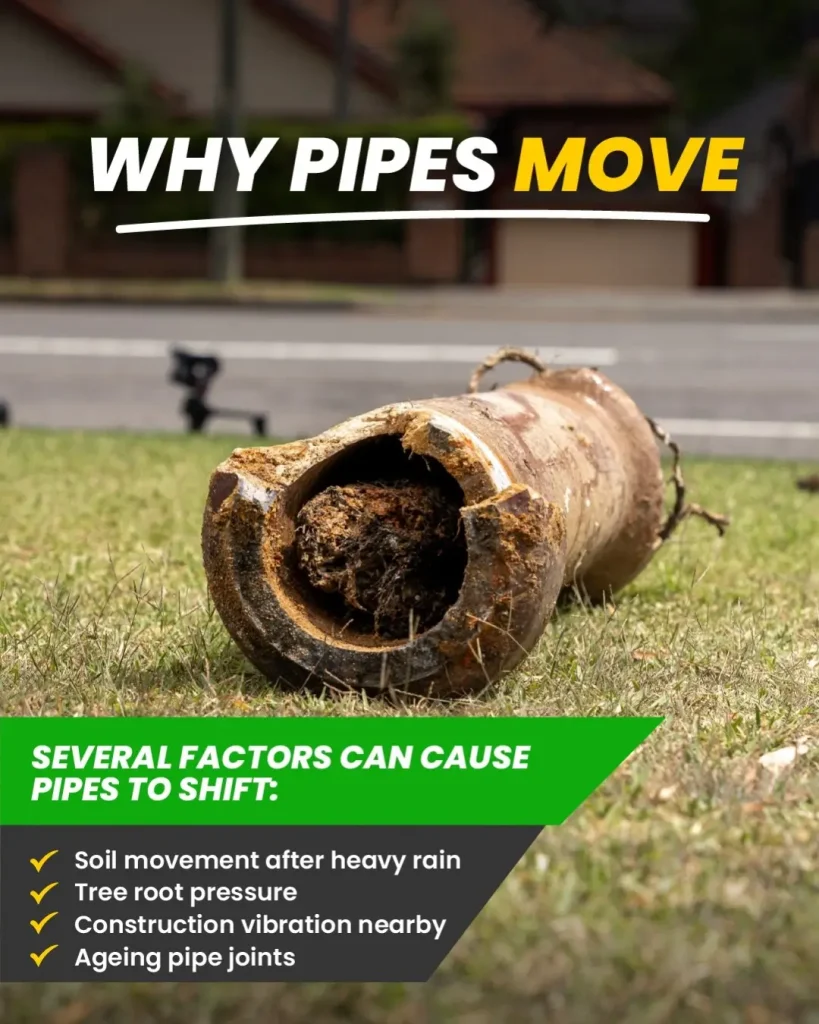
why pipes move in sydney
Much of Sydney sits on clay soil, and clay is basically a sponge, it swells up when it gets wet and shrinks back when it dries out. Every time it rains, the ground around your pipes pushes outward. Every time it dries, it pulls away. Over the years of this constant push-and-pull, your pipes slowly get shifted out of position, joints crack open, and pipes start to sag or tilt.
Roots don't just grow into your pipes. They grow around them, too. As a root mass expands outside the pipe, it acts like a slow-motion crowbar, physically shoving the pipe sideways or upward. Over time, even a well-installed pipe can be lifted or shifted out of alignment by a determined root system from a tree that's 10 to 20 metres away.
All soil compacts and settles over time from the weight of the ground and structures above it. The problem is when one part settles faster than another, one end of a pipe drops, the other doesn't, and now you've got a tilt. Water pools in the sag, debris builds up, and the pipe starts failing. This is especially common in Sydney suburbs built on imported fill or reclaimed land.
After a big rain, the water table rises, and groundwater pushes up against everything underground, including your pipes. For older clay pipes with any existing crack or weakness, water pressure forces its way in (or forces the pipe wall out), widening cracks and washing away the supporting soil around the pipe.
Pipes buried near the surface, especially under driveways and paving, heat up in summer and cool down overnight. They expand and contract with every temperature change, which is fine on its own. But after thousands of cycles over decades, the stress at every joint gradually loosens them. It's like bending a paper clip back and forth eventually, something gives.
Excavators, pile drivers, road works, and even nearby NBN trenching send vibrations through the soil. That vibration disturbs the compacted ground that holds your pipe firmly in place. Once that bedding is disturbed, the pipe settles into a new, uneven position often with a sag or a misaligned joint where there wasn't one before.
A 60-year-old clay pipe has thinner walls, more cracks, and far less structural strength than when it was installed. What it is used to resist is soil pressure, root forces, and water pressure. It can no longer handle. So, the same forces that did no damage for fifty years now start winning. The pipe cracks, shifts, and eventually collapses under pressures a younger, stronger pipe would shrug off.
Understanding why pipes shift is one thing. Understanding what that shifting actually does to your drainage system and your property is equally important.
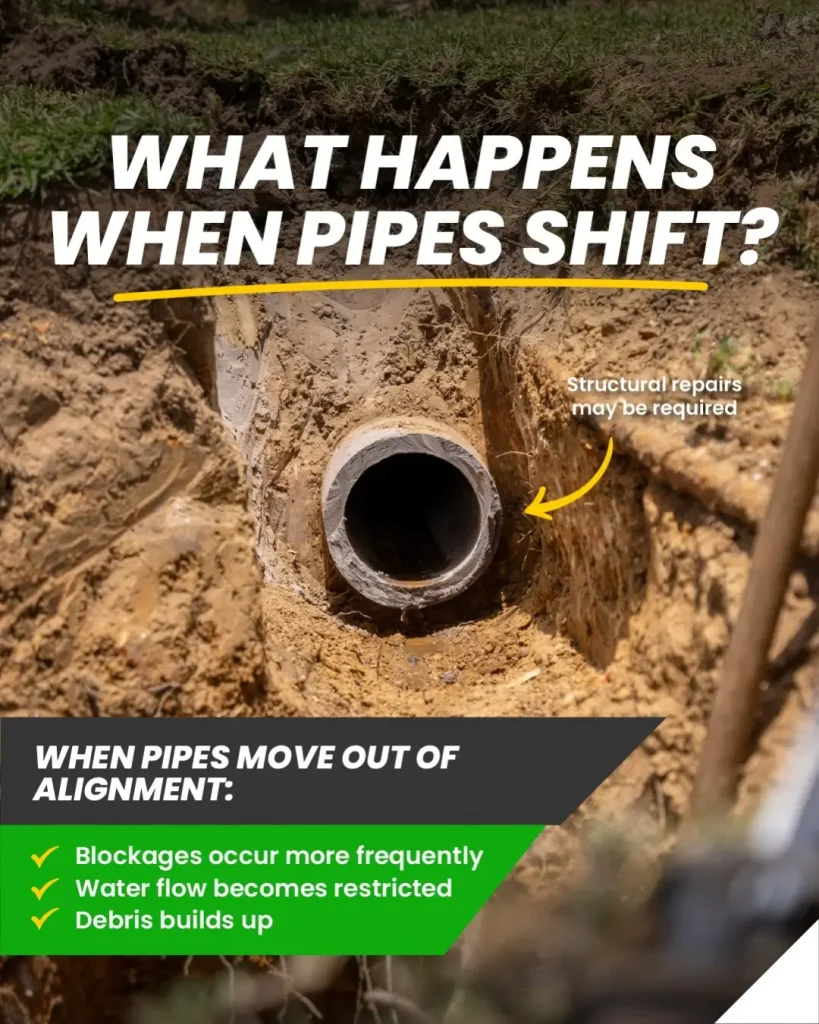
what happens when pipes shift
In this stage, the damage is invisible from above. You may notice slightly slower drainage or a subtle change that's easy to attribute to a minor blockage. There may be faint sewage odours on still days. Your water bill might creep up as groundwater infiltrates the system and has to be treated. But most homeowners at Stage 1 have no idea anything is wrong.
Once a joint is open or even slightly mean it is an open invitation to tree roots seeking moisture. Root intrusion typically begins within one to three years of joint separation in areas with established trees, and it progresses quickly. By the time roots are blocking flow, they have usually been growing in the pipe for years and have exerted significant physical force on the pipe structure, widening the opening they entered through and sometimes displacing the pipe further in the process.
This is the classic symptom pattern of root intrusion, and it's the point at which Sydney Drain Surgeons most commonly receives calls for CCTV drain camera inspections.
As shifting continues and roots widen existing openings, the pipe wall itself begins to crack. Cracks introduce new water infiltration points, further destabilise the surrounding soil, and create additional sites for root entry. Pipe will experience multiple drains backing up, sewage odours throughout the property, wet patches appearing in the garden above the pipe run, and sometimes visible subsidence of paved areas where the soil beneath has been washed away by escaping water.
A collapsed pipe cannot carry wastewater at all, and the resulting sewage backup creates an immediate health hazard as well as a plumbing emergency. Collapsed pipe repair in Sydney has traditionally required full excavation, but that's no longer the only option.
This is where the story gets genuinely good.
Not long ago, fixing a shifted, cracked, or collapsed underground pipe in Sydney meant one thing: excavation. Today, trenchless pipe relining in Sydney has changed that equation completely.
Sydney Drains Surgeons used a method of repairing damaged underground pipes from the inside, without excavation. A high-strength epoxy resin liner is inserted through an existing access point and cured in place against the inner wall of the damaged pipe, creating a seamless, jointless new pipe within the old one that can actually last for 50+ years.
If your drains are telling you something isn't right, listen to them. The fix is faster, cheaper, and far less disruptive than you probably think.
Book a CCTV drain camera inspection today and let Sydney Drain Surgeon show you exactly what's going on before the problem decides for you.
How do I know if my pipe has shifted and needs relining?
The most reliable way is a CCTV drain camera inspection. Symptoms that suggest pipe shifting include recurring drain blockages, gurgling sounds in the drain system, sewage odours, wet patches in the yard, or visible subsidence above a pipe run. Call us, and we'll book an inspection often on the same day.
Can pipe relining fix a pipe that has already partially collapsed?
In many cases, yes, particularly where the collapse is partial, and the pipe retains enough structure for the camera and liner to traverse. Fully collapsed sections may require spot excavation to replace just the collapsed portion before the adjacent sections are relined. We assess this on inspection and advise honestly on the best approach.
How long does a pipe relining job take?
Most standard residential sewer relining jobs in Sydney are completed within a single day, including inspection, cleaning, relining, and post-reline inspection. The drain is back in service the same day in the majority of cases.
Does no-dig pipe restoration prevent future tree root problems?
Yes. The cured epoxy liner seals all existing joints and cracks through which roots previously entered. The smooth internal surface of the liner is root-resistant under normal conditions. Root re-entry at relined sections is extremely rare, making relining the most effective permanent solution for recurring root intrusion problems.